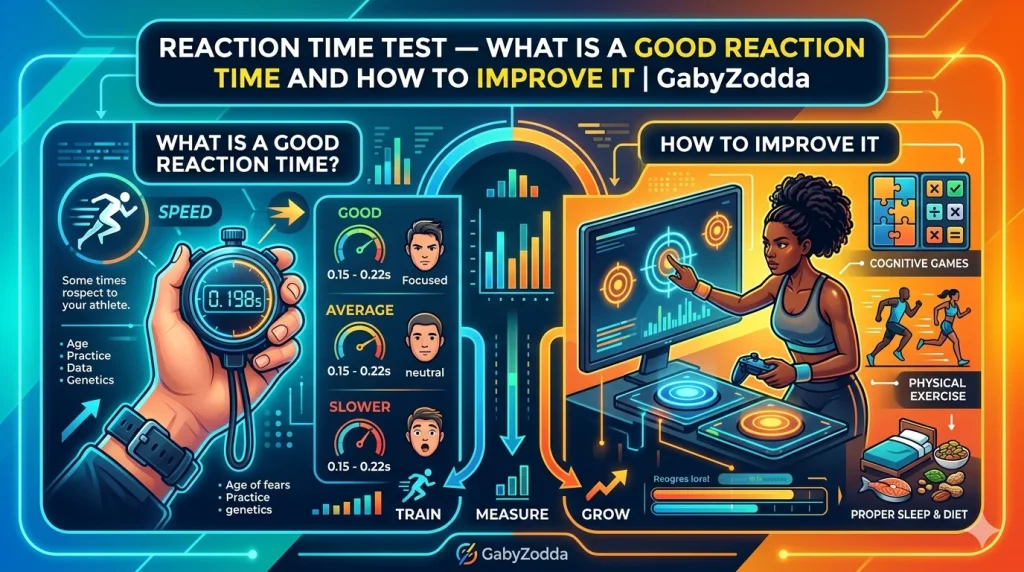
Best Reaction Time Test — What Is a Good Reaction Time and How to Improve It
Take a free reaction time test online and find out how fast your reflexes really are. See exactly how you compare to competitive gamers and the average human, plus proven tips to improve your reaction time fast.
How fast are your reflexes? Whether you are a competitive gamer looking to shave milliseconds off your response time, a driver interested in your safety margins, or simply curious where you stand against the average human, a free reaction time test gives you a clear, measurable answer in seconds. This guide explains everything you need to know about reaction time benchmarks, what affects your score, and how to improve it consistently.

⚡ Free Reaction Time Test
Test your reflexes right now — 5-attempt average, instant millisecond results, completely free.
What Is Reaction Time?
Reaction time is the interval between a sensory stimulus — such as seeing a color change on screen — and your physical response, such as clicking a mouse button. It is one of the most fundamental performance metrics for competitive gaming, sports science, and driving safety research. Our reaction time test measures this interval precisely in milliseconds so you can track your baseline and monitor improvement over time.
Reaction time is typically measured in milliseconds (ms). In GabyZodda’s reaction time test, you wait for a green signal to appear on screen and click as fast as possible. The time between the visual change and your click is your reaction time for that attempt. The tool averages five attempts to give you a statistically meaningful result rather than a single lucky or unlucky reading.
According to research published in the National Library of Medicine, simple visual reaction time averages approximately 250 milliseconds in healthy adults, while trained athletes and esports professionals can achieve significantly lower times through deliberate practice and optimized setups.
Average Human Reaction Time — How Do You Compare?
Use the benchmark table below to see where your reaction time test score places you compared to the general population and specialized groups:
| Reaction Time | Rating | Who This Describes |
|---|---|---|
| Under 150ms | Elite | Top professional esports players, elite athletes |
| 150–200ms | Excellent | Competitive gamers, trained athletes |
| 200–250ms | Good | Regular gamers, active young adults |
| 250–350ms | Average | General population average (around 250ms) |
| 350–500ms | Below Average | Fatigued, distracted, or less practiced individuals |
| Over 500ms | Slow | Very tired, intoxicated, or significantly distracted |
What Affects Your Reaction Time Test Score?
Factors That Slow Your Reaction Time
- Fatigue: Sleep deprivation can increase reaction time by 50–100ms or more, making this one of the biggest factors affecting your test score
- Age: Reaction time peaks around age 24 and gradually increases after that — a natural physiological change that practice can partially offset
- Distractions: Background noise, multitasking, and high mental load all add measurable delay to your reaction time test results
- Caffeine absence: For regular caffeine consumers, skipping it can noticeably slow reflexes and increase reaction time by 10–20ms
- Cold muscles: Physical warmup improves reaction time in sports and gaming contexts alike
Factors That Speed Up Your Reaction Time
- Regular practice: Consistent reaction time test sessions train your brain’s neural pathways for faster visual responses over weeks of practice
- Caffeine: Moderate caffeine intake reduces reaction time by 10–30ms for most people
- Warmup attempts: Running 2–3 warmup attempts before your scored reaction time test primes your neural pathways
- High-refresh monitor: A 144Hz or 240Hz display reduces visual latency significantly compared to a standard 60Hz monitor
- Quality peripherals: A high-polling-rate mouse (1000Hz+) and low-latency keyboard reduce the input lag between your physical response and the registered click
Can You Improve Your Reaction Time?
Yes — with consistent, deliberate practice. Your brain forms faster neural pathways through repetition, similar to how muscle memory develops in sports. Research on neuroplasticity shows that regular reaction training produces measurable improvements, most dramatically in the first few weeks of practice before results begin to plateau.
The most effective approach is to combine regular reaction time test sessions for measurement with dedicated aim training or reflex training apps that specifically target the visual-motor response chain. Passive gaming alone improves reaction time less efficiently than targeted reaction testing.
Reaction Time in Gaming — Does It Matter?
In fast-paced competitive games like Valorant, CS2, and Apex Legends, the difference between a 200ms and 250ms reaction time test score translates directly to who shoots first in a close-range encounter. At the highest levels of professional play, this 50ms gap can decide rounds and matches consistently.
However, raw reaction time is only one factor in gaming performance. Aim precision, crosshair placement, game sense, positioning, and decision-making collectively matter far more at most skill levels. A 10ms improvement in reaction time is significantly less impactful than 100 hours of deliberate aim training or map knowledge development.
According to PLOS ONE research on action video games and reaction time, regular action game players demonstrate measurably faster reaction times than non-gamers, suggesting that sustained gaming does provide genuine cognitive benefits for visual processing speed.
Best Practices for Taking the Reaction Time Test
Warm Up Before Testing
Cold hands and an unprimed nervous system will produce artificially high reaction time test scores. Run 2–3 warmup attempts before recording your official average. Your first attempt in any session is almost always your slowest due to neural cold-start effects.
Stay Relaxed — Do Not Anticipate
Trying to anticipate the stimulus and clicking early is called a false start, and any reaction time test worth using will penalize or discard these attempts. Genuine reaction time is measured from stimulus to response, not from anticipation to click. Relax your grip and wait for the actual signal rather than tensing up in preparation.
Test Consistently at the Same Time of Day
Fatigue, nutrition, and circadian rhythm all affect fine motor performance. For accurate progress tracking, take your reaction time test at the same time of day under similar conditions. Most people perform best in mid-morning after caffeine intake and a meal, and worst in the late evening when fatigue accumulates.
Use a High-Refresh Monitor if Possible
On a standard 60Hz monitor, the visual stimulus can only appear at a 16.7ms frame boundary, adding up to 16.7ms of unavoidable display latency to your result. A 144Hz monitor reduces this to 6.9ms. For the most accurate reaction time test results, use the highest refresh rate display available to you.
Related Performance Testing Tools on GabyZodda
After completing your reaction time test, try these related free tools to benchmark other aspects of your hardware performance and physical capabilities:
- Typing Speed Test — measure your WPM, accuracy, and error rate in 60 seconds
- Click Speed Test — test how many clicks per second you can achieve
- Keyboard Tester — verify every key on your keyboard registers correctly
- Mouse Polling Rate Test — verify your mouse input frequency for gaming accuracy
- Key Ghosting Test — check how many simultaneous keypresses your keyboard supports
